When people first hear the word cryptocurrency, they often assume it refers to one single type of digital money. In reality, the crypto ecosystem is much broader and more innovative. It includes several distinct categories of digital assets, each designed with its own purpose, strengths, and use cases.
Understanding these differences is an important step for any beginner, because it helps you see how this technology is evolving beyond simple payments into an entirely new financial system.
Examples: Bitcoin (BTC), Ethereum (ETH)
Cryptocurrencies—often called coins—are the foundation of the digital asset world. These assets operate on their own independent blockchains, which are decentralized networks that no single entity controls.
Bitcoin was the first cryptocurrency and is often described as “digital gold.” Many people use it as a store of value, similar to how gold has been used historically.
Ethereum expanded on Bitcoin’s idea by introducing programmable blockchain capabilities, enabling developers to build entire applications on top of it.
Key Uses:
Storing value over time
Sending money globally without banks
Serving as the backbone for broader crypto ecosystems
Why it matters: Coins represent the core idea behind crypto: financial systems that are open, borderless, and not dependent on centralized intermediaries.
Unlike coins, tokens are built on existing blockchain platforms (such as Ethereum). They don’t have their own independent blockchain; instead, they operate within a larger ecosystem.
Tokens are incredibly versatile and can represent many different things, including:
Utility: Access to a product or service (think of tokens as a digital “key”)
Governance: Voting power in decentralized projects or organizations
Assets: Ownership of something, whether digital or real-world
For example, a token might allow you to:
Use a decentralized app (dApp)
Participate in decision-making for a project
Gain access to exclusive features or communities
Why it matters: Tokens are what make crypto programmable and expansive. They allow entirely new types of digital experiences, from decentralized finance (DeFi) to online communities and beyond.
Stablecoins are designed to maintain a steady value, typically pegged to a traditional (fiat) currency such as the U.S. dollar.
Examples include:
USDC (USD Coin)
USDT (Tether)
OGUSD (Old Glory Bank’s planned stablecoin)
Unlike cryptocurrencies such as Bitcoin, which can fluctuate in price, stablecoins aim to remain consistent.
Key Benefits:
Reduced price volatility
Easier on-ramp for beginners
Useful for trading, saving, or sending funds
However, many stablecoins rely on centralized backing mechanisms, such as reserves held by companies or institutions.
Why it matters: Stablecoins bridge the gap between traditional finance and crypto, offering the speed and accessibility of blockchain technology with the familiarity of stable value.
Central Bank Digital Currencies (CBDCs) are digital forms of money issued and controlled by governments or central banks. While they may adopt some of the same technological foundations as cryptocurrencies, they differ in one critical way: CBDCs are fully centralized and operate under government authority.
This distinction raises important concerns, especially when compared to the decentralized, user-controlled nature of most cryptocurrencies.
Key Characteristics of CBDCs
Centralized control: Every aspect of a CBDC is managed by a central authority, giving governments direct oversight over the creation, distribution, and use of money.
Programmability: CBDCs could allow institutions to place conditions on how funds are spent, when they can be used, or even if they can expire.
Traceability: Transactions may be monitored, recorded, and potentially analyzed by central authorities, reducing financial privacy for individuals.
While CBDCs are often presented as a modernization of money, these features introduce significant trade-offs. Greater efficiency in payments may come at the cost of reduced personal control, privacy, and financial independence.
Unlike decentralized cryptocurrencies—where individuals can hold and transfer assets without intermediaries—CBDCs could expand the ability of centralized institutions to oversee and influence financial behavior at a granular level.
Why It Matters: CBDCs represent a shift toward a more controlled and surveilled financial system, rather than the open, permissionless model that defines most of the crypto ecosystem.
For those who value financial liberty, this distinction is critical. The rise of CBDCs highlights the importance of preserving alternatives, like decentralized cryptocurrencies, where individuals retain greater ownership, autonomy, and choice over their financial lives.
Be sure to read Old Glory Bank’s insight on Crypto Vs CBDC.
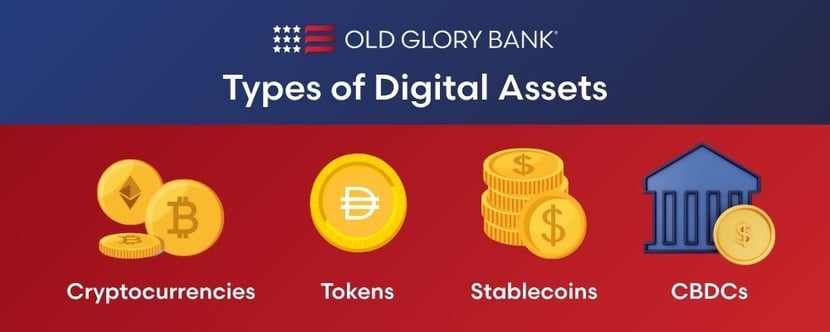
As you can see, “crypto” is not just one thing. It’s a spectrum of technologies and financial tools. Each type of digital asset reflects a different philosophy about how money and systems should work:
Decentralized coins emphasize independence and resilience
Tokens drive innovation and new digital economies
Stablecoins focus on usability and stability
CBDCs reflect government-led digital finance
One of the most powerful aspects of the digital asset movement is choice. For the first time, individuals can participate in multiple financial systems simultaneously—traditional banking, decentralized crypto networks, or new hybrid models.
From a crypto-positive perspective, this is a major step forward. It encourages:
Rather than relying on a single system, individuals can decide what works best for their own needs and values.
Old Glory Bank is planning to be one of the first banks in America to offer traditional banking and crypto in one unified platform, providing our customers with a seamless experience, whether they choose one or both financial approaches. We view this unification of traditional finance and crypto as the culmination of our mission to preserve Privacy, Security, and Liberty in banking.
The future of finance isn’t about replacing one system with another. It’s about expanding options.
Whether you’re drawn to the independence of cryptocurrencies, the innovation of tokens, the stability of stablecoins, or simply exploring how everything fits together, understanding these categories gives you a strong foundation to navigate the evolving digital economy.